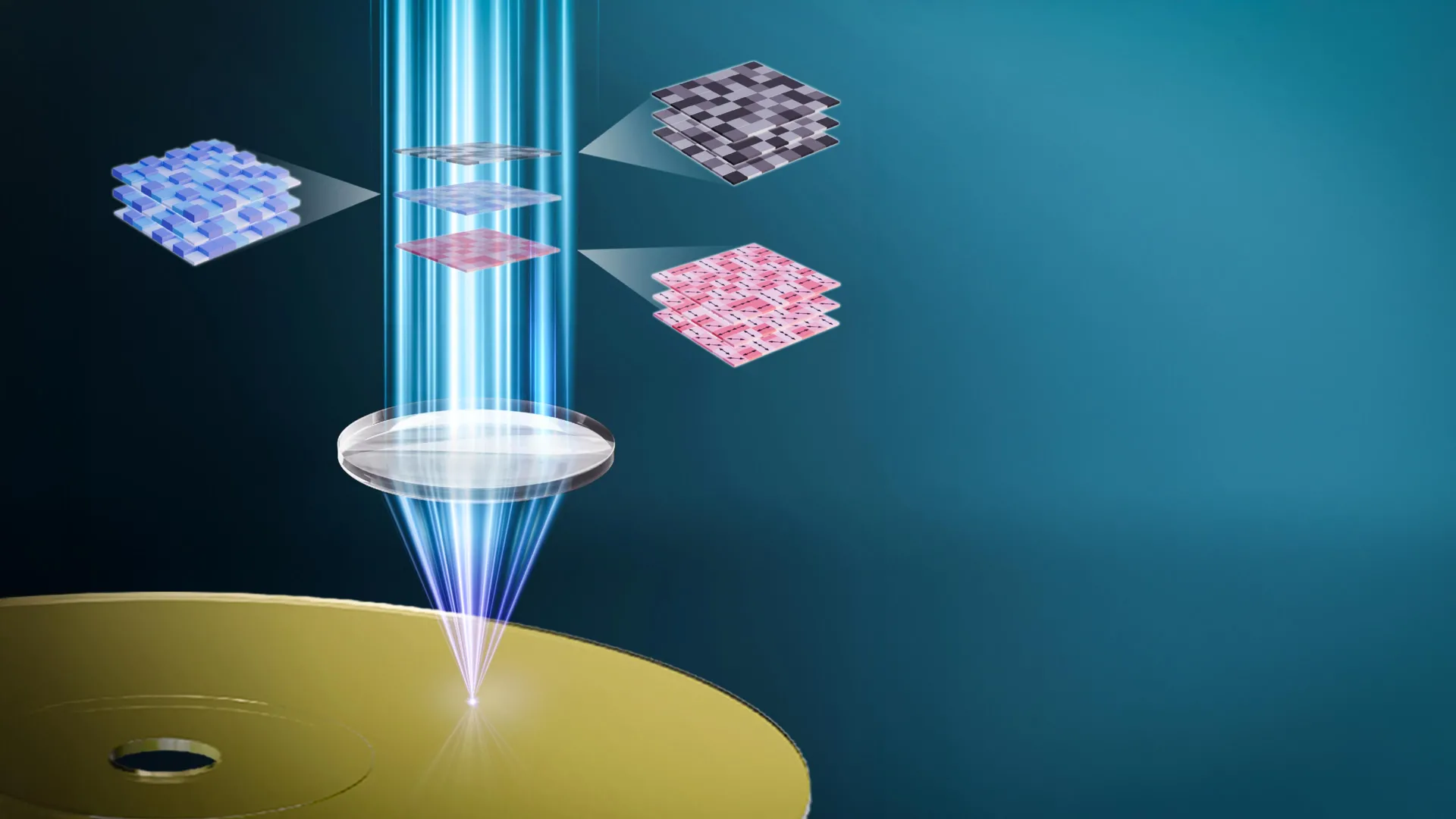
Researchers have developed a new holographic data storage system that records and retrieves information in three dimensions by combining three important aspects of light – amplitude, phase and polarization. By using these three together, this method allows more data to be stored in one place, providing a potential solution to the world’s growing demand for data storage.
Traditional storage systems write data to flat surfaces such as hard drives or optical discs. On the other hand, holographic data storage includes information across a range of materials using laser light. This enables multiple lighting systems within the same area, which greatly increases storage capacity and enables faster data transfer.
“In a typical data storage environment, data encoding usually uses one light such as amplitude or phase alone, or, more often, combines two of these measurements,” said research team leader Xiaodi Tan of Fujian Normal University in China. “Based on the principle of polarization holography, we used a deep learning framework known as a convolutional neural network model to enable the use of polarization as a measure of independent information.”
Research, published in SERVICEOptica Publishing Group’s journal for high-impact research, shows that this new method can increase the amount of information stored while making it easier to find it.
“With continued development and commercialization, this type of multidimensional holographic data storage can enable small data centers and large-scale archive storage, while improving data processing and transmission performance,” said Tan. “It can also contribute to secure data transmission, optical encryption and advanced imaging.”
Using Polarization to Enhance Data Coding
In holographic storage, information is stored as image-like data sheets created using laser light techniques. Encoding converts the digital data on these pages, while decoding converts them into usable information.
Although light has many tools that can be used to move large amounts of data, integrating them properly has been difficult in practice. In order to overcome this, the researchers refined a technique called tensor-based polarization holography, which maintains the state of polarization during reconstruction. This makes polarization a reliable channel for storing more information.
Based on this work, the team developed a 3D modulation coding scheme. By changing the intensity and phase of two perpendicular polarization states and using a two-phase hologram method, they have enabled a single spatial modulator to include amplitude, phase and polarization together in the optical field.
AI Decoding of Multidimensional Light Data
Determining this combined information is difficult because conventional sensors only measure light intensity (amplitude) and cannot detect phase or polarization directly. To address this, the researchers used the theory of tensor-polarization holography together with a convolutional neural network to obtain all three types of data from dynamic diffraction images.
The neural network is trained using two complementary diffraction images, one taken with a vertical polarizer and the other without. By analyzing these images, the model learns to distinguish patterns related to amplitude, phase and polarization. This allows it to rebuild three at the same time, improve storage capacity and boost data transfer speed.
Towards Faster and High-Performance Data Storage
After validating the concept, the researchers built an integrated device capable of recording and reproducing the optical field embedded in a polarization-sensitive material. During the analysis, dynamic images were analyzed to find signatures related to amplitude, phase and polarization. These were used as inputs for neural networks, enabling full 3D reconstruction using only force-based measurements.
“Overall, our results showed that multidimensional composite coding greatly increased the information carried by a single sheet of holographic data, thereby improving the storage capacity,” said Tan. “In addition, neural network synchronous decoding reduced the need for complex measurements and step-by-step reconstruction, supporting more accurate reading and editing. This could lead to a more efficient way to store high-quality, high-quality holographic information.”
Next Steps for Real World Applications
The researchers emphasize that the system is still in the research stage and needs further development before it can be used in business. Future work will focus on increasing the gray levels used in coding to further expand capabilities, as well as improve long-term stability, such as repeatability of recording devices.
They also plan to combine this method with volumetric holographic multiplexing techniques, which would allow multiple pages and channels of data to be stored at once. Strengthening the integration between optical devices and identification algorithms will be important to achieve faster and more accurate data retrieval under real-world conditions.
#Scientists #store #large #data #light #layers