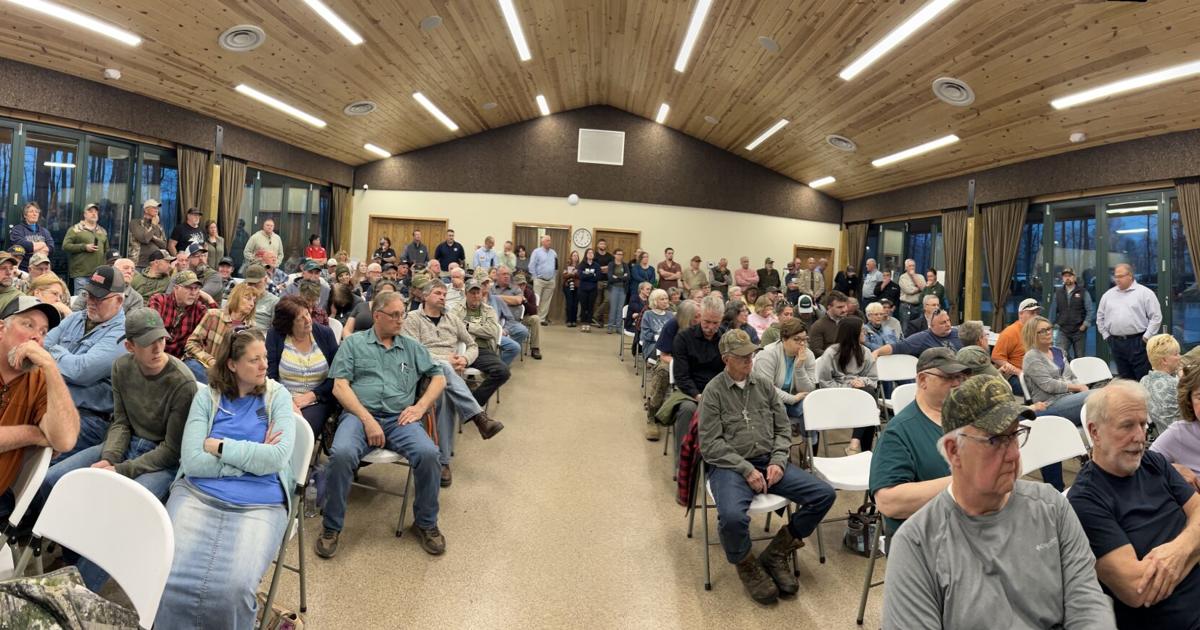
BENEZETTE – It was standing room only March 26 in the Jack and Jean Parker Outdoor Room near the Elk Country Visitor Center to discuss Pennsylvania’s elk herd.
State Representative Michael Armanini welcomed everyone and noted that taxpayer dollars paid for the beautiful location they were in, and that Benezette is officially known as the “elk capital of Pennsylvania,” a major tourist destination. The problem is that elk are becoming scarce in an area where they were once abundant.
He added that he is working with the Pennsylvania Game Commission, the Department of Conservation and Natural Resources (DCNR) and the Keystone Elk Country Alliance (KECA) “to find ways to restore the prime elk viewing areas of Winslow Hill and Dents Run, and restore the beauty of elk so that more people can look at them. Outsiders or sportsmen can come and see their beauty.”
The first Benezette resident to speak was the owner of MacDarvey Castle and Elk View, Chuck Brotherton. He said: “I came here about 15 years ago from New Jersey, and I came here for one reason: because of the abundance of wildlife in Benezette.” The group I used to come with called this place the ‘Little Yellowstone of the East’ because (the wildlife) was so abundant.
“I bought all the equipment (I could) and spent tens of thousands of dollars to live here depending on that. And I feel that today, it is not there. When I came here I used to go out with KECA and Rocky Mountain to capture elk and tag it.
“KECA has done a wonderful job of bringing in students and families with their exhibits and their films. They get everyone uplifted and everyone is excited to understand the nature of elk. Some are unlike when I first came here I was driving my 80 year old mother and we could easily see 50 to 100 elk every night.”
Surrounding counties have begun distributing pamphlets that provide GPS locations where elk can be found, and it’s no longer Benezette. He suggested that the visitor center has 100,000 fewer visitors than it did before the epidemic, and asked that some roads near food places be opened to visitors so that even the elderly can enjoy seeing the elderly without getting out of their cars.
Another speaker asked if organizations such as the Bennetts Valley Sportsmen Club, Pheasants Forever, and other conservation-minded organizations that have the equipment, volunteers, and expertise to create supplemental food plots for elk on private property would be allowed to do so. It was suggested that organizations join together to get more lime and seeds to create food gardens that are more accessible than most established areas. It was clarified that most of the food centers grown and controlled by KECA or the Game Commission are located in remote areas with limited access, which does not solve the problem of a small number of insects being easily seen on the roads as was the case a few years ago.
Peggy DeCarli has owned the Medix Hotel for 27 years, and she said that, in the past, the elk were often in the hotel parking lot and across the street from the convenience store. It was the attraction that brought people to the area, and they supported his business and other businesses in the area. He asked if the only areas that could be seen at the moment were those near the remote and inaccessible areas monitored by the Game Commission and KECA.
Another speaker was wildlife photographer Bruce Watkavich who is not from the area, but has been visiting here every month for about 20 years. He said: “When I came here 20 years ago, I had to come to Benezette to find the cows, because that’s where the cows were. The noise of people and contact with the animals will be where they want to be, but they are still there.” Watkavich noted that last year’s long drought caused bulls to move to better pastures. He concluded by saying: “We know that we want to keep more (chickens) in the Benezette area, but we have also seen that the elephants are spreading.
Another speaker was octogenarian Terry Moore, and he said he has lived in Benezette since 1959, and has seen many changes over the years. He credited KECA and the Game Commission for their work in reclaiming the mining lands and turning them into pastures.
He said, “But the biggest change that’s happened here is that we’re not allowed to feed elk in our yard anymore. I’ve fed elk for 30 years, as have my neighbors, and when you go past the campground or down by the store, you’d see elk. There were always a few of them running around. They were there because people were feeding them.
Moore noticed that the elk he fed were always healthy, and they did not get chronic wasting disease (CWD) from being fed as a group. He noted that the $500 fee for feeding elk on private land was introduced at one time because it made the elk happy and dependent on people for food, and said that is the reason why elk are not seen when people drive Benezette.
One resident recalled meetings he went to 30 years ago where people complained that their yards were too big, and they were honking their horns at cars. Since there were no food fields, the deer grazed on grass, shrubs and garden produce on private land. People wanted the vermin to be relocated as they had become a destructive nuisance. They wanted the elk to go and they wanted the tourists to go. The Game Commission responded by creating more habitat in a larger area, and the elk have moved on, away from roads and homes.
The PGC does not recommend transporting the parasites from one location to another because of the risk of spreading chronic wasting disease, according to elk biologist Jeremy Banfield.
#Residents #voice #concerns #declining #elk #sightings #Benezette