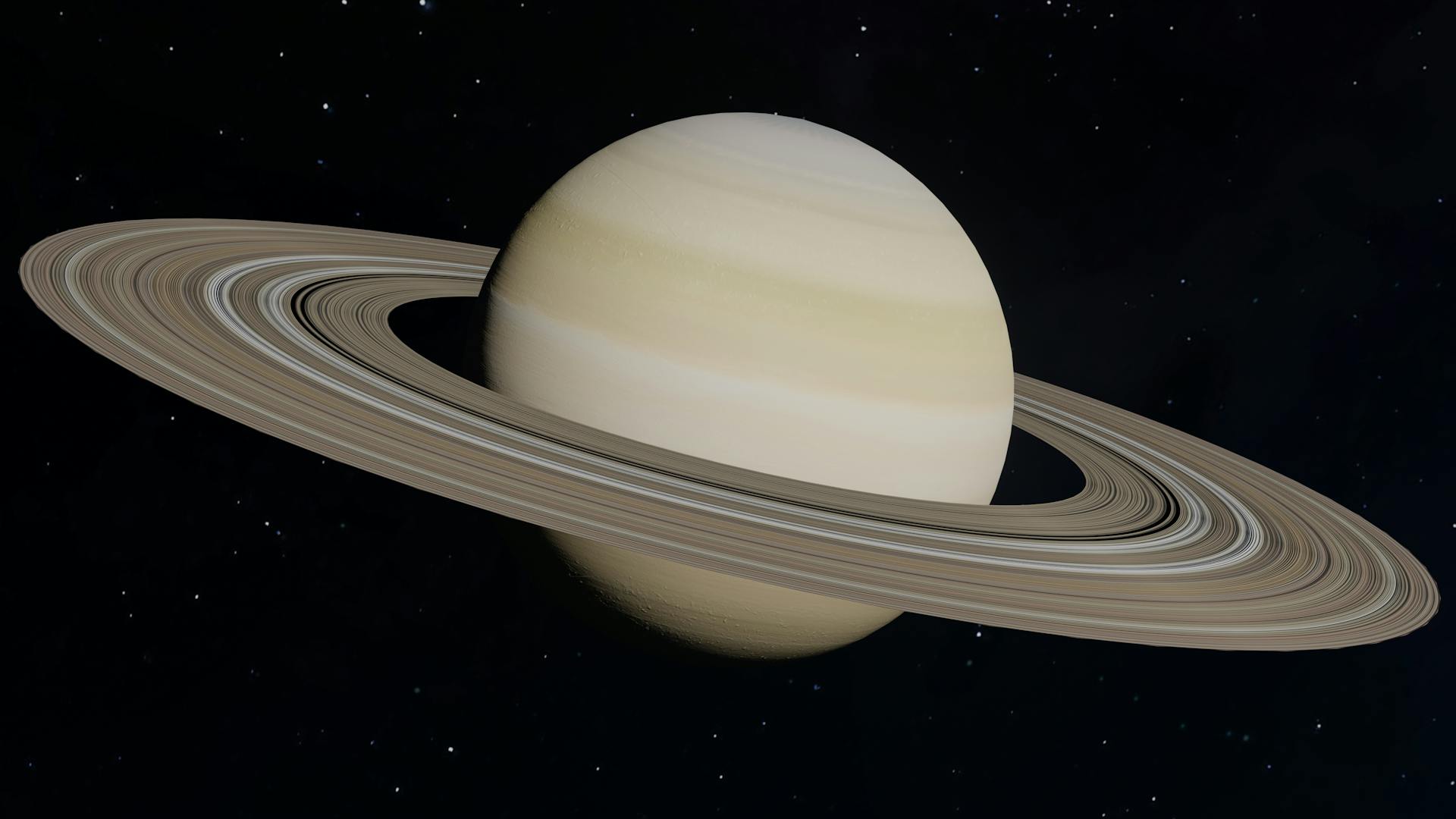
For decades, Saturn has played a surprising trick on scientists. Depending on how they measured it, the giant planet appeared to be rotating at different speeds, which shouldn’t be the case for a rotating solid body.
This surprising discrepancy has challenged planetary physics and raised doubts about how scientists interpret signals from distant worlds.
Now, using the incredible power of the James Webb Space Telescope (JWST), a new study reveals that the real reason for this illusion is an independent layer driven by Saturn’s auroras.
“For decades, we knew there was something strange going on in the apparent speed of Saturn’s rotation, but we couldn’t explain it,” said Tom Stallard, lead author of the study and professor at Northumbria University.
“We then showed that it is driven by atmospheric winds, but we still didn’t know why those winds exist. These new observations, made by JWST, finally give us the evidence we need to close that loop,” Stallard added.
Finding an invisible engine
The mystery is similar to observations by NASA’s Cassini in 2004, which suggested that Saturn’s orbit is changing over time. That didn’t make sense because planets don’t just accelerate or decelerate without an outside force.
Years later, scientists suggested that the signal used to measure rotation was not coming from the center of the planet at all, but from the upper atmosphere. The high winds above Saturn generated electrical currents, creating a misleading auroral signal that mimics changes in rotation.
However, this explanation raised another question—what was driving those powerful spirits in the first place?
To find out, researchers turned to the James Webb Space Telescope, the most advanced telescope ever built. They focused on Saturn’s northern aurora—the planet’s version of the northern lights—and maintained it continuously for an entire Saturn day (10 hours 33 minutes).
This view allowed them to capture detailed, time-resolved changes across the auroral region. The key to their success was a molecule called trihydrogen cation (H₃⁺).
This molecule glows with infrared light and acts as a natural thermometer for the upper atmosphere. By following its glow, scientists mapped the temperature and particle density across Saturn’s poles.
Earlier measurements had large uncertainties (errors of about 50°C), making it difficult to detect subtle trends. However, Webb’s data were about ten times more accurate, revealing efficient heating and cooling systems for the first time. What emerged was surprising. The hottest areas correspond exactly to where the auroral energy enters the atmosphere.
“What we’re seeing is actually a planetary heat pump. Saturn’s aurora heats its atmosphere, the atmosphere moves the air, the winds generate currents that power the aurora, and so on.
Not just about Saturn’s rotation
This discovery goes a long way toward explaining Saturn’s mysterious orbit. It reveals a deep, two-dimensional relationship between a planet’s atmosphere and its magnetosphere—the surrounding magnetic sphere.
Energy does not simply flow from space to space; the atmosphere itself helps control what happens in the space around the planet. This understanding could change the way scientists interpret signals from other powerful gases, in our planetary system and beyond.
It may affect the way researchers study exoplanets, where similar auroral processes can affect the behavior of the atmosphere.
“This result changes the way we think about the atmosphere of the planet in general. If the atmospheric conditions of the planet can drive waves in the surrounding space, then understanding what is happening in the stratospheres of other worlds may reveal interactions that we have not yet imagined,” said Stallard.
This study was published in the journal JGR Space Physics.
#planet #defies #physics #Webb #reveals #secret #Saturns #mysterious #rotation