For decades, nuclear activity has been the center of proposals for aeronautical engineering and government studies, always promising, never leaving the laboratory. That changes in 2028.
NASA has announced that it will launch the Space Reactor-1 Freedom, described by the agency as the first nuclear-powered interplanetary spacecraft, on its way to Mars before the end of the year. The project, called Skyfall, will transport a fleet of small helicopters to the Martian surface. But helicopters can end up being a secondary topic. A travel-enhancing reactor could change the way humans travel in deep space.
The propulsion technology onboard the SR-1 Freedom is known as nuclear electric propulsion, or NEP. It works with an onboard fission reactor that produces heat, which is then converted into electricity to drive high-efficiency electric motors.
This is in contrast to the radioisotope thermoelectric generators that have been powered by probes such as Voyager for decades; those systems use the heat from radioactive decay for power but have no propulsion component. The NEP is an active propulsion system, and unlike solar panels, it operates at any distance from the sun, making it particularly suitable for missions to the outer planets.
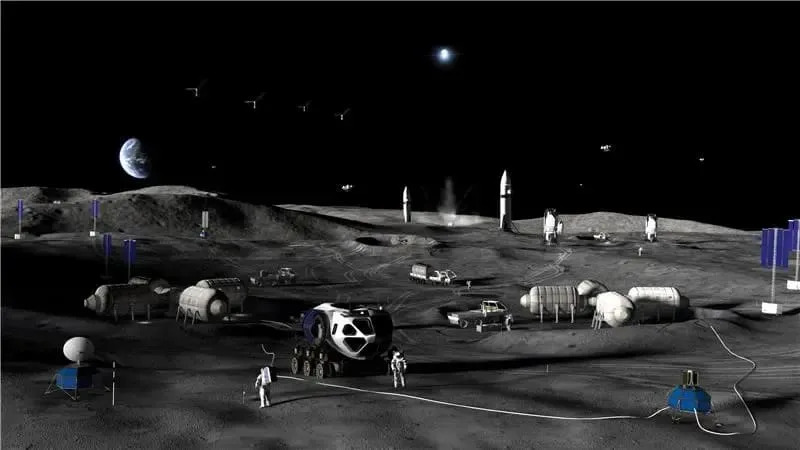
NASA’s Moon Base Phase 3 creator’s concept. (CREDIT: NASA)
Three helicopters and a fission reactor.
The Skyfall helicopters will be similar in design to the Ingenuity, a small rotorcraft that reached Mars with the Perseverance rover in February 2021 and continues to complete 72 flights before the mission ends in January 2024. The Ingenuity was built as a technology demonstration. The Skyfall ship has a more focused mission.
Three helicopters will survey the landing area, using cameras and ground-penetrating radar to map the area, assess hazards, and identify areas of underwater ice. The location of that water, and information about its depth and distribution, will be important information for any future manned mission to the surface.
“They will also map and characterize groundwater ice to determine where the water ice is located, as well as its size, depth and other important characteristics,” said Steve Sinacore, program manager for NASA’s Office of Space Reactors.
If the mission schedule holds, SR-1 Freedom will launch in December 2028 and reach Mars about a year later. After sending the Skyfall helicopters, the spacecraft may continue outside the solar system, although that part of the mission plans has not been finalized.
NASA considers the NEP to be more than just a project. “SR-1 Freedom will establish the nuclear legacy of the flight, set the rules and launch the model, and activate the industrial base for future fission energy applications throughout long-term, high-end and long-duration missions,” the agency said in a statement.
That speech indicates a long desire. Nuclear power is considered essential for efficiently transporting large payloads to the outer planets, where solar energy is ineffective, and for supporting high-power systems on spacecraft operating during multi-year missions.
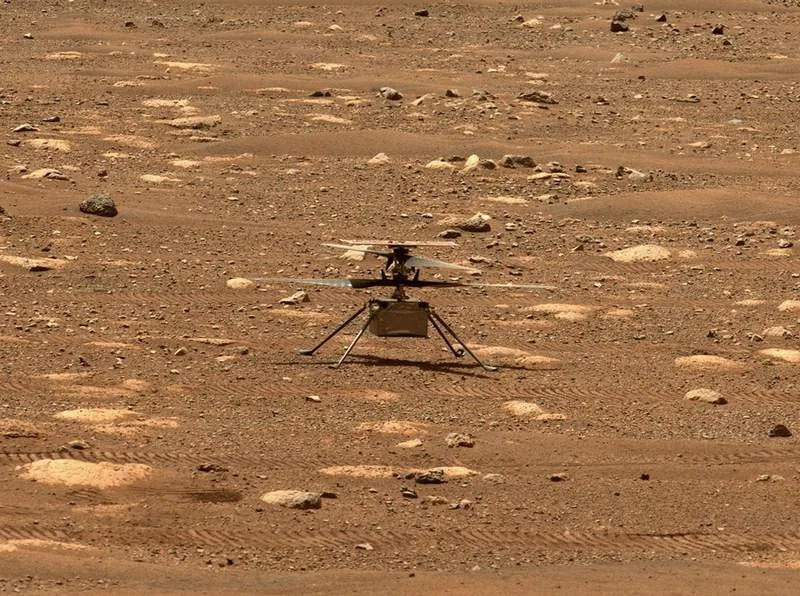
Mars Helicopter Intelligence on Mars. (CREDIT: NASA)
A comprehensive reset at NASA
The Skyfall announcement was part of a larger NASA event called “Ignition”, which was held on March 24, where the agency outlined a series of major changes to its exploration strategy.
Among the most important: NASA is suspending the development of Gateway, the planned space station orbiting the moon, to focus on building a permanent base on the lunar surface. Some of the Gateway equipment will be sold to the outside world.
The lunar base project is organized in three stages, starting with the first buildings using small living spaces, then progressing to permanent facilities with contributions from international partners including Japan, Italy and Canada, and finally reaching a permanent human presence.
NASA Administrator Jared Isaacman created the moment in a dramatic way. He said: “The clock is ticking in this superpower competition, and success or failure will be measured in months, not years.
On Earth, NASA announced that it is considering a new plan to leave the International Space Station without creating a gap in the presence of the American people. The proposal involves connecting the main government module to the current station, then gradually adding commercial modules that will eventually detach and operate independently. The information industry application opened on March 25.
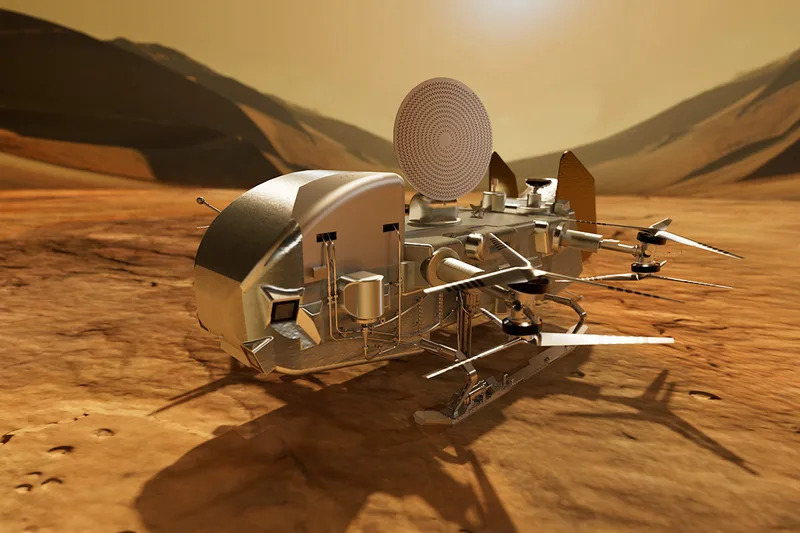
An improved version of the Dragonfly aircraft. (CREDIT: NASA/Johns Hopkins APL/Steve Gribben)
Scientific activities are progressing
Many other works received notable mentions during the announcements. The Dragonfly mission, a nuclear powered octocopter, is on schedule to launch in 2028 and reach Saturn’s moon Titan in 2034 to study its bio-rich environment. NASA has also confirmed that it will send the European Space Agency’s Rosalind Franklin Rover to Mars in 2028, with a large spectrometer designed to search for life.
The Nancy Grace Roman Space Telescope, intended to advance the understanding of dark energy, is set to launch early this fall. A new global science project that will start next year will, for the first time, measure the internal strength of severe storms in real time, with the aim of improving extreme weather forecasts six hours before the event.
NASA also announced plans to expand its Commercial Lunar Payload Services program, targeting up to 30 lunar robots starting in 2027, with rewards open to contributions from industry, academia and international partners.
The meaning of nuclear power in deep space
The SR-1 Freedom’s practical weight goes beyond its specific purpose. Nuclear power makes the transportation of large quantities of cargo through deep space more efficient than anything currently available. Beyond Mars, it becomes the only viable option for transporting large amounts of energy near Jupiter and beyond, where the sun’s rays cannot produce enough energy.
By demonstrating the technology in flight, developing nuclear control systems in space, and building the industrial supply chain needed to support future systems, this mission is designed to serve as the infrastructure for everything that comes after it. Crewed Mars missions, robotic explorers of the outer planet, stable lunar operations that require a lot of constant energy, all of them depend on solving the problem of driving first.
Skyfall’s helicopters will explore Mars. The SR-1 release, if all goes as planned, will make way for all the other planets.
The first story “America’s nuclear-powered space shuttle is headed for Mars, and it’s bringing helicopters” was published on The Brighter Side of News.
Related Stories
Like these kind of good stories? Get a glimpse of the Bright Side of the News.
#American #nuclear #spaceship #heading #Mars #bringing #helicopters