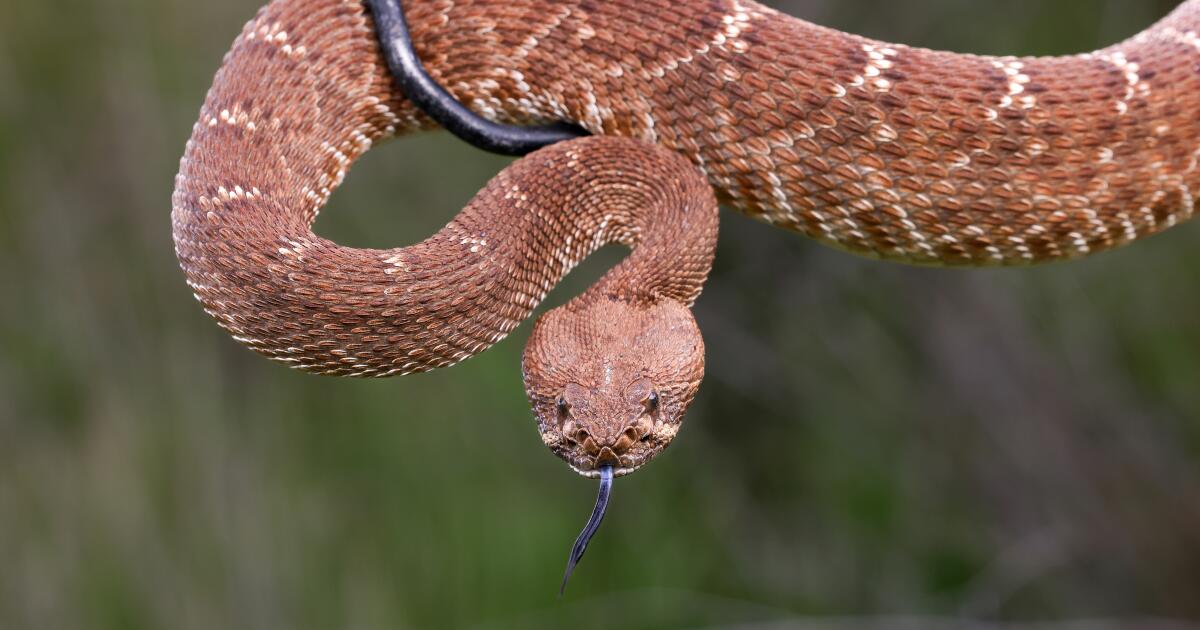
Emily Taylor has lived in California for 20 years and has never received as many calls about rattlesnakes as she did last month.
Taylor owns Central Coast Snake Services, a snake consulting business, runs the Physiological Ecology of Reptiles Laboratory at Cal Poly San Luis Obispo and is part of a network of volunteers who help relocate rattlesnakes to the wild.
His phone was “ringing off the hook,” he said, with people calling about snake sightings from all over the country.
In March, two people were bitten by a rattlesnake in southern California alone, a 46-year-old woman from Ventura County and a 25-year-old man from Orange County. Nationwide, about five people die from rattlesnake bites each year, according to health officials. Ventura County has reported four rattlesnake bite incidents since March 14, compared to nine in 2025.
The California Poison Control System reported 77 calls about rattlesnake bites in just the first three months of 2026. On average, Poison Control reports 200 to 300 rattlesnake bites each year.
In his work on the Central Coast, Taylor said he has answered calls from people who have encountered rattlesnakes in their yards.
“Usually we only get one or two [calls] in March before it gets crazy in April,” he said.
Taylor said he already has 10 to 20 times the number of calls he usually gets from people in his area.
Why? Simply put: Snakes have been very active – and so have people.
Unusually warm weather patterns, including an unprecedented heat wave in March, drove rattlesnakes out of their winter habitats in search of food and mates a month before the normal start of rattlesnake season, Taylor said. Likewise, warmer temperatures have forced outdoor enthusiasts to hit the trails, increasing the chances of encounters with snakes.
Common rattlesnake season
Rattlesnake season is a misnomer in California because they are active year-round, meaning rattlesnakes can be seen year-round.
But they’re less active in the winter, Taylor said, so you’re less likely to see it.
The snake may slither in the winter if there’s a warm breeze to get sunlight, said Greg Pauly, curator of herpetology at the Los Angeles County Historical Society.
Pauly said: “As the temperature warms in the spring, we see a dramatic increase in surface activity during the day. After eating nothing or very little in the winter months, rattlesnakes are looking for food in the spring and looking for mates.
Rattlesnakes like to hide in hard rocky places, long grass and squirrel holes. In mountainous areas, such as Big Bear, several rattlesnakes will live together in burrows. In low-lying areas including Los Angeles, rattlesnakes have underground burrows that are home to one or maybe two snakes, Taylor said.
The peak period of rattlesnake activity usually occurs from April to October; It’s also when the California Poison Control Department receives the most calls about rattlesnake encounters.
That started the first rattlesnake season
Rattlesnake activity is largely controlled by local weather, Pauly said.
“Rattlesnakes use warm temperatures,” Taylor said, “as a cue when it’s time to come out and start working.”
This year, unusually warm weather in March, abundance of vegetation and healthy prey were the first signs for rattlesnakes to begin their activity.
Pauly said: “We’ve had good rains in early winter followed by unusually warm weather. “With good plant growth, rodents are doing well, so the snakes have good food sources and the warm temperatures are causing a lot of surface activity.”
Rattlesnakes thrive in warm temperatures, especially in the 70s to low 80s.
Lately, the temperature has been dropping at night, so most of their work takes place during the day.
“Unfortunately,” Taylor noted, “that led to a lot of ugly rattlesnakes.”
Later in the rattlesnake season, Pauly said, “the temperature in the lower areas will be too high for a lot of snake activity during the day, and the snakes will be active in the morning, evening and later into the night.”
So, snakes work. Should we be afraid?
Taylor and Pauly want to set the record straight about rattlesnakes, whose representation as evil or evil snakes is inappropriate, they say.
Here are a few myths that experts have debunked.
Legend: Rattlesnakes lie in wait to bite people.
Details: Rattlesnakes do not want to be associated with humans. Rattlesnakes are vulnerable to being hit by cars and exposed to rodenticides, Pauly said.
Conflict with humans is bad news for rattlesnakes because people often try to kill them, Taylor added.
“As a result, rattlesnakes tend to be in undeveloped areas, which is why they are often seen when people are hiking in the wilderness,” Pauly said.
A rattlesnake’s first line of defense is to hide, Taylor noted.
Although snakes use their venom to defend themselves, studies have shown that the chemical nature of snake venom is very suitable for killing its prey, such as mice.
Rattlesnakes “produced this venom millions and millions of years before humans existed in North America.”
He said that Rattlesnakes would rather save their venom to defeat their prey.
Legend: You can always know that there is a snake nearby, because you will hear its sound.
Fact: Individual rattlesnakes, like individuals, vary greatly in how they interpret threats, Pauly said.
Some rattlesnakes may be disturbed by a person 20 meters away and howl in hopes that the person will leave the area.
“Some rattlesnakes prefer to rely on their camouflage and may not rattle or move until a human is very close,” he said.
So, experts say it’s a good idea to be aware of your surroundings when you’re out on foot.
Be careful — but don’t write off rattlesnakes as evil, experts say. They play an important role in the environment, eating rodents, such as ground squirrels, which often carry diseases such as hantavirus, plague and Lyme disease.
If the snake’s prey has seeds on their cheeks, “they will disperse those seeds, acting as natural gardeners, taking the seeds out of a small compost pile,” Taylor said.
Also in the rattlesnake win column, their venom has been a major source of inspiration for medical treatment, Taylor said. He said that scientists are investigating how snake venom can treat cancer, stroke and Alzheimer’s disease.
What to do if you encounter a rattlesnake
Death from a rattlesnake bite is rare. About 8,000 people are bitten by venomous snakes each year, and — despite two recent deaths in Southern California — only about five of those bites die, according to the Centers for Disease Control and Prevention.
If you see a rattlesnake in the wild, experts say the best thing to do is put some distance between you and it. Slowly back away from the snake.
“Don’t come back so soon because … you [could] trip and hurt yourself,” said Taylor.
If you’re wondering if you’re too far, Pauly said, now you’re too close. He said that when a snake strikes, “they strike faster than people can react when they strike.”
“Give rattlesnakes at least three to four feet of space, even more for adults,” he said. “Move away, take a few photos to upload to a public science platform like iNaturalist, and then let yourself and the snake continue your journey.”
While enjoying the trail, stick to the marked path and avoid walking in tall grass or areas where you can’t see the ground.
During the trip, if you need to rest on a tree or rock, make sure you check it before you sit down.
#idea #wonderful #time #rattlesnake